Put the soil to work for resilient crops
A healthy soil is the foundation for a strong crop. But what truly makes soil healthy? Brightlabs and Soil Vision have jointly developed a smart analysis method that reveals how soil life functions and how you can optimize it. "It is a more representative way of looking at the soil."
When a farmer sows their fields or a grower plants blueberries, they want to be sure the soil is in good condition: with sufficient nutrients but without heavy metals. A proper soil analysis is important for the quality and growth of open-field crops.
According to Tommie Heijmans, Business Development Manager at Brightlabs, traditional analyses focus primarily on the chemical and physical properties of the soil, whereas the combination with microbial processes is crucial for a complete picture of plant health and crop resilience. "Adding fertilizer is quickly seen as a solution when a crop isn't doing well. In most cases, the majority of the nutrients are available, but the plant simply cannot absorb them."
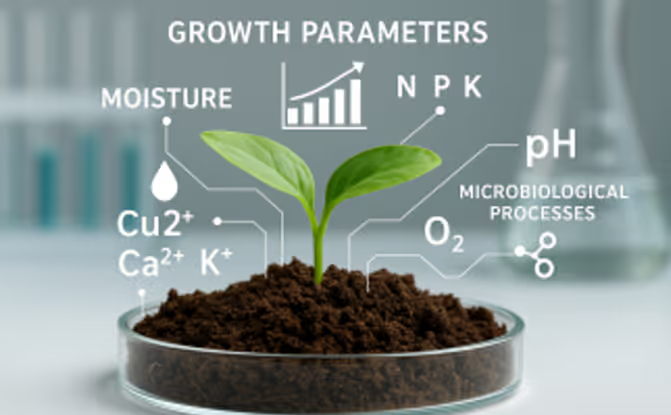
According to Tommie, a healthy soil is all about the balance between the soil environment (pH level, oxygen in the soil, and organic matter quality), chemistry (available nutrients and total reserves), and microbiological processes (bacteria and fungi). "With Soil Insight 2.0, we take all three of these aspects into account. We combine our expertise in chemical and physical soil analyses with the microbiological knowledge of Soil Vision, giving farmers and growers insight into the current status and the potential of their soil."
Microbiome
According to Tommie, focusing on the total soil process provides more insight than standard analyses. "We approach the soil as a living organism, in which microbiological life—the bacteria, fungi, and other organisms in the soil—works closely with the crop. The focus is not on the plant itself, but on optimizing the soil environment and its associated processes. This creates an environment in which the crop can nourish and protect itself naturally."
A gram of fertile soil contains millions of microorganisms, each with its own 'job' in the soil: they work together with the roots of the plants and trees growing in it. They are the link in the soil for releasing and converting nutrients. "Without this cooperation, plants cannot develop properly," says Tommie.
Understanding the soil
Soil Insight 2.0 helps to better understand the soil, provides insight into the soil's potential, and shows which processes are taking place within it. "In the lab, we simulate what happens in the soil and map out its current state. This analysis reveals whether the soil environment is suitable for the organisms that carry out these processes and clarifies whether additional (trace) elements—sulfur, potassium, boron, nickel, molybdenum—need to be added and in what form. This gives a farmer or grower insight into the condition of their soil and whether it is suitable for the crops they are growing or want to grow. If that is not the case, it can be adjusted, creating a soil environment in which chemical, physical, and biological processes function optimally."
Resilient crops
A good soil environment ensures that the plant's health and resilience are increased and that the right minerals are made available for plant growth. "We must handle our soil with care in the Netherlands. Space is limited, and the square meters we have available must yield increasingly higher returns. Furthermore, European policy is aimed at reducing the use of fertilizers and crop protection products. That makes a different solution necessary, and it is already hidden in the soil. We provide advice on optimizing soil reserves and put microbiology to work. This results in a strong crop."
Ecosystem
Brightlabs and Soil Vision found each other through the ecosystem of the Brightlands Campus Greenport Venlo. "Through the campus, we quickly get in touch with other parties who are also working on a healthy future, including Soil Vision. By combining our expertise, we can make the soil in the Netherlands a bit healthier. Campus resident Compas Agro has also indicated that they want to start using Soil Insight 2.0. This new analysis method is interesting for anyone who works with soil, including municipalities, nature and environmental organizations, engineering firms, and cultivation advisors."

Science is only as good as the people behind it.
Brightlabs was founded on a simple belief: that analytical chemistry is most valuable when driven by genuine scientific curiosity and a commitment to doing things the right way.
The complete overview of what Brightlabs does.
Download our brochure for a complete overview of our analytical capabilities, services, and scientific approach.